Ready to begin your training?
Book your slot for the upcoming PHTLS batch on 30-31 Dec 2026.
About PreHospital Trauma Life Support
PHTLS is developed by NAEMT in cooperation with the American College of Surgeons' Committee on Trauma. It is based on the belief that, given a good fund of knowledge and key principles, EMS practitioners are capable of making reasoned decisions regarding patient care.
Certified By
National Association of Emergency Medical Technicians
Validity
4 years
Eligibility
EMTs, paramedics, nurses, physician assistants, physicians and other prehospital providers.
Pre-course Tasks
PHTLS covers the following topics:
- Physiology of life and death
- Scene assessment
- Patient assessment
- Hemorrhage control
- Airway
- Breathing, ventilation, and oxygenation
- Circulation and shock
- Special populations
Read them well before coming.
Course Day Preparation
- Arrive on time
- Wear comfortable clothing
- Do not skip Breakfast as skill sessions could be intense
- Some part can be outdoor. Use sunscreen.
Agenda
Day 1: Foundations and Primary Assessment
- Registration & Introduction: Course overview and pre-test.
- Philosophy of Trauma Care: Understanding kinematics of trauma, injury mechanisms, and the physiology of life and death.
- Scene and Patient Assessment: Emphasizing the X-ABCDE approach (eXsanguinating hemorrhage, Airway, Breathing, Circulation, Disability, Exposure).
- Airway, Breathing, and Ventilation: Hands-on management of respiratory distress, airway obstruction, and tension pneumothorax.
- Shock and Hemorrhage Management: Identifying types of shock, fluid resuscitation protocols, and advanced bleeding control (tourniquets, hemostatic dressings).
Day 2: Specific Injuries and Patient Scenarios
- Specific Traumatic Injuries: Focused modules on trauma to the head, spine, chest, abdomen, and musculoskeletal system, as well as burns and environmental injuries.
- Special Populations: Trauma considerations for pediatric, geriatric, and pregnant patients.
- Disaster Management & Mass Casualties: Pre-hospital triage decisions and disaster response frameworks.
- Practical Skills Stations: Hands-on practice for airway control, spinal immobilization, and trauma assessment.
- Patient Simulations: Team-based trauma scenarios and case studies to test critical thinking in high-pressure situations.
- Final Examination: Written test and final mega-code or scenario practical testing.
For Hybrid format, Day 1 will be online lectures and Day 2 will feature are skill stations.
Renewal Process
Refresher Course: 8-hour classroom course for individuals who have successfully completed the 16 hour PHTLS provider course within the past four years.
Additional Information
This course may be offered as a full 16hr classroom course, or a hybrid course where students take 8 hours of the course online followed by 8 hours in the classroom.
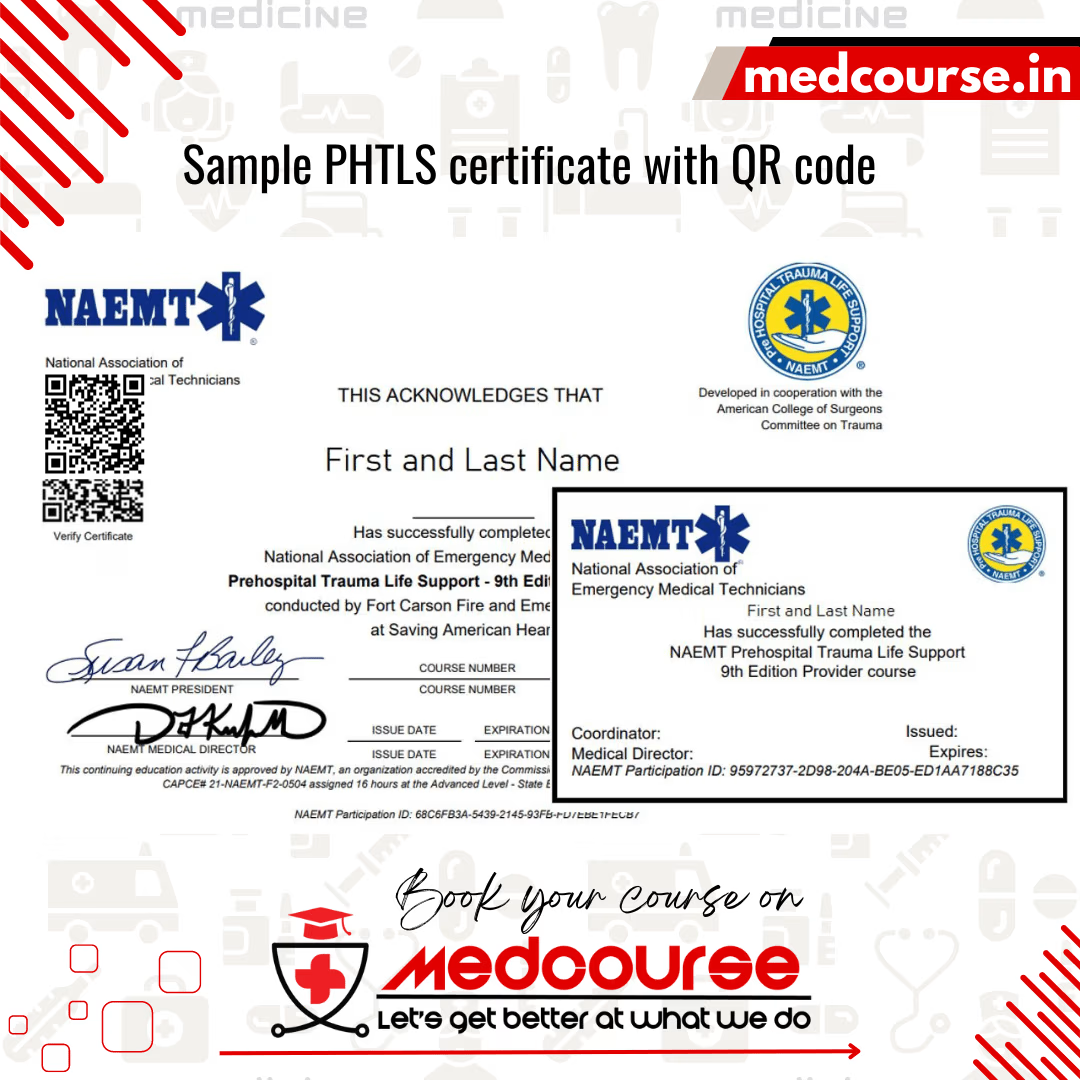
Sample Certificate
Ready to secure your booking?
Registration for this upcoming batch in Hyderabad is filling up fast. Reserve your seat today to avoid disappointment.
Book Your SeatFrequently asked questions
How long is PHTLS certification valid?
PHTLS certification is valid for 4 years.
Who is PHTLS for?
EMTs, paramedics, nurses, physician assistants, physicians and other prehospital providers.
What topics does PHTLS cover?
- Physiology of life and death
- Scene and patient assessment using the X-ABCDE approach
- Hemorrhage control, airway, breathing, ventilation and oxygenation
- Circulation and shock
- Specific injuries, special populations (pediatric, geriatric, pregnant patients) and mass casualty triage
What formats are available?
PHTLS can be a full 16-hour classroom course, or a hybrid where you complete 8 hours online followed by 8 hours in the classroom. Check your batch details for the format offered.
What should I bring and wear on the course day?
- Arrive on time
- Wear comfortable clothing
- Do not skip breakfast, as skill sessions can be intense
- Some parts can be outdoors, so use sunscreen
How do I renew PHTLS?
Take the 8-hour Refresher course. It is for people who completed the 16-hour PHTLS Provider course within the past four years.